ServiceTitan Pantheon AI booking, ServiceTitan AI tools, AI booking software for ServiceTitan, AI scheduling ServiceTitan
5 min read
Going to ServiceTitan Pantheon? A Practical Checklist for Evaluating AI Booking

October 7, 2026





Home service companies do not need one giant AI project. They need a clear starting point in the customer journey. The practical question is not “Where can we use AI?” It is “Where is work piling up, customers waiting, or revenue getting lost?”
AI is showing up across home services: teams use it to write marketing copy, summarize calls, answer routine questions, follow up with leads, and help dispatch teams work faster. Those are all useful applications. But the biggest gains come when the tools connect instead of becoming another disconnected inbox, dashboard, or handoff.
Answer: Most home service companies should adopt AI one workflow at a time, starting at the point where customer demand is getting stuck. For some teams, that is an unanswered phone. For others, it is a website lead with no fast response, an office team retyping intake details, or an appointment that never reaches the field-service system.
Map the path from the homeowner’s first question to the job on the board. Then find the first delay, duplicate task, or dead end. That is the right place to test AI.
AI can help marketing teams build pages, draft campaign variations, organize reviews, and respond to website visitors. The useful standard is not simply engagement. It is whether a visitor with a real service need gets a clear next step.
For a homeowner, “I need someone to look at my AC” should not end with a generic contact form and a promised callback. A guided experience can collect the basics, answer common questions, and move an eligible visitor toward scheduling. ScheduleBot’s AI Chat and AI Forms help contractors turn website intent into structured, actionable intake.
AI voice is most valuable when it covers the repeatable first part of an inbound conversation: identify the service need, confirm the address, collect the right details, and route the next step. It should support the office team, not pretend every customer situation can be handled without people.
CSRs still need to handle complex conversations, escalations, financing, memberships, and exceptions. AI can help protect after-hours demand, peak-season overflow, and calls that arrive while the team is already helping another customer. See how AI Voice fits into a connected intake workflow.
This is the point where a lot of AI pilots fall apart. A tool may capture a lead or create a nice conversation, but the office still has to decipher notes, re-enter the information, and figure out whether an appointment can actually be offered.
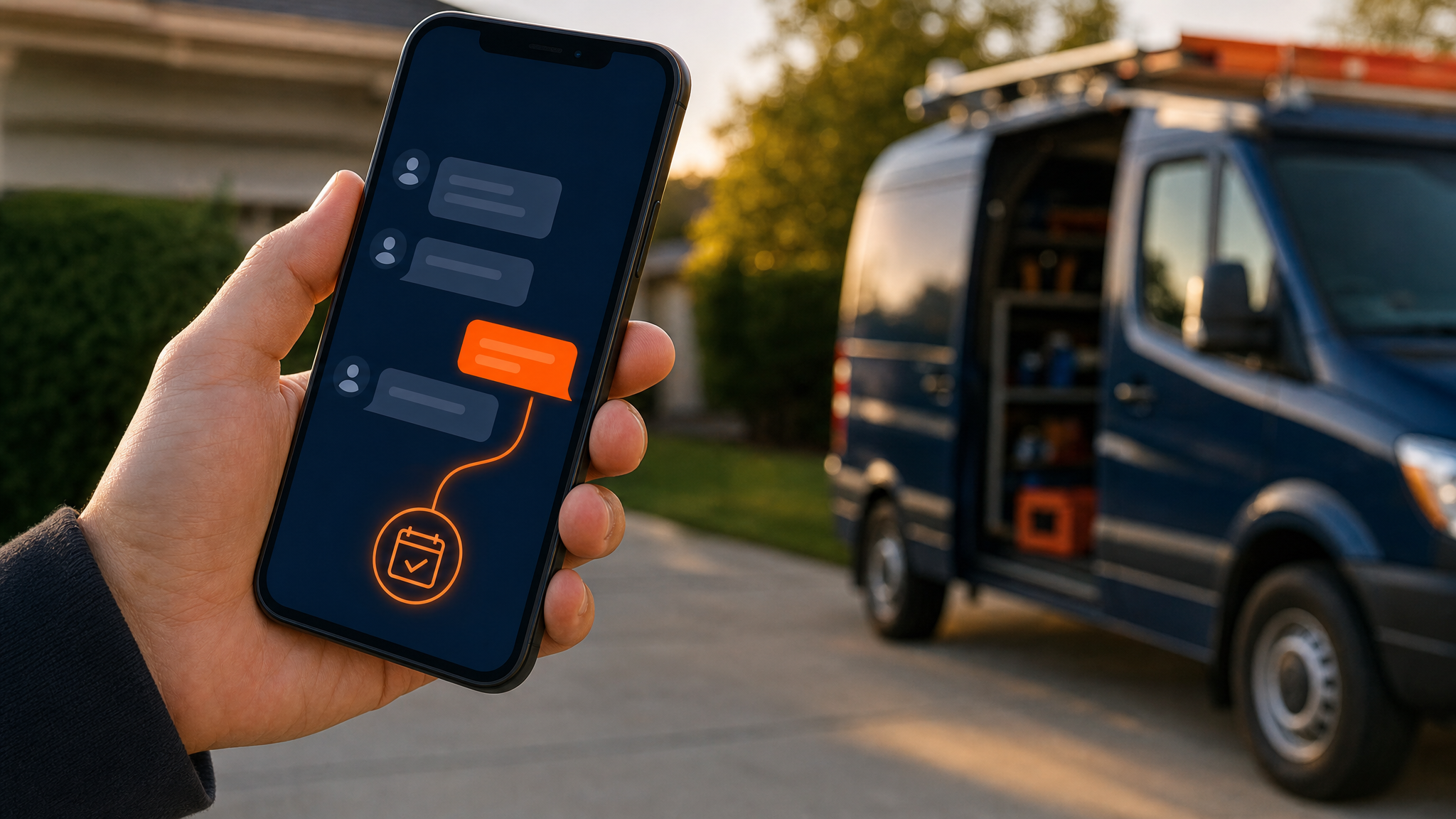
Booking is where customer intent meets service area, job type, business hours, emergency rules, available capacity, and CRM requirements. ScheduleBot sits in that layer. It helps turn a qualified call, chat, or form submission into a booking path that works with the rules the business already operates by.
For a deeper look at that layer, read AI booking software for home service companies.
AI can summarize intake details, flag urgency, and give dispatchers or technicians a clearer picture before they act. The goal is not to outsource judgment. It is to reduce the time spent chasing missing information and to make handoffs less error-prone.
Set the boundaries clearly. The business should define which jobs can be scheduled automatically, which need office review, and what counts as an emergency. That keeps speed from becoming a promise the operation cannot keep.
Many customers start a conversation but do not finish a form, answer a callback, or select an appointment. A thoughtful follow-up workflow can give them an easy way back in. It should be timely, specific to their request, and connected to the same intake record, so they do not have to repeat their story.
Do not judge follow-up by message volume or replies alone. Measure whether qualified customers reach a booked appointment and whether the office has the context needed to help them.
AI works best when it respects the systems the business already runs. That means connecting the intake and booking experience to the CRM or field-service platform rather than creating another place for the team to check.
For contractors on ServiceTitan, the question is not whether AI can answer a call. It is whether the right job, lead, or appointment reaches the right workflow. Our guide to ServiceTitan scheduling automation explains where a booking layer can extend the system of record.
ScheduleBot is the booking layer for home service companies adopting AI across their customer journey. It connects AI Voice, AI Chat, AI Forms, SMS, and CRM-aware scheduling so customer intent has a path to a real operational outcome.
The goal is not “more AI.” It is fewer lost opportunities, cleaner handoffs for the office, and more qualified jobs on the board.
Start at the customer journey’s clearest bottleneck, such as missed inbound calls, slow website responses, incomplete booking intake, or manual follow-up. Use one workflow and measure the booked outcome before adding more.
No. AI can handle repeatable intake and routing tasks, while CSRs and dispatchers retain judgment for complex requests, escalations, and exceptions.
It should connect to the business’s real service rules, availability, and system of record so the office can act on the result without re-entering information.