ServiceTitan Pantheon AI booking, ServiceTitan AI tools, AI booking software for ServiceTitan, AI scheduling ServiceTitan
5 min read
Going to ServiceTitan Pantheon? A Practical Checklist for Evaluating AI Booking

October 7, 2026





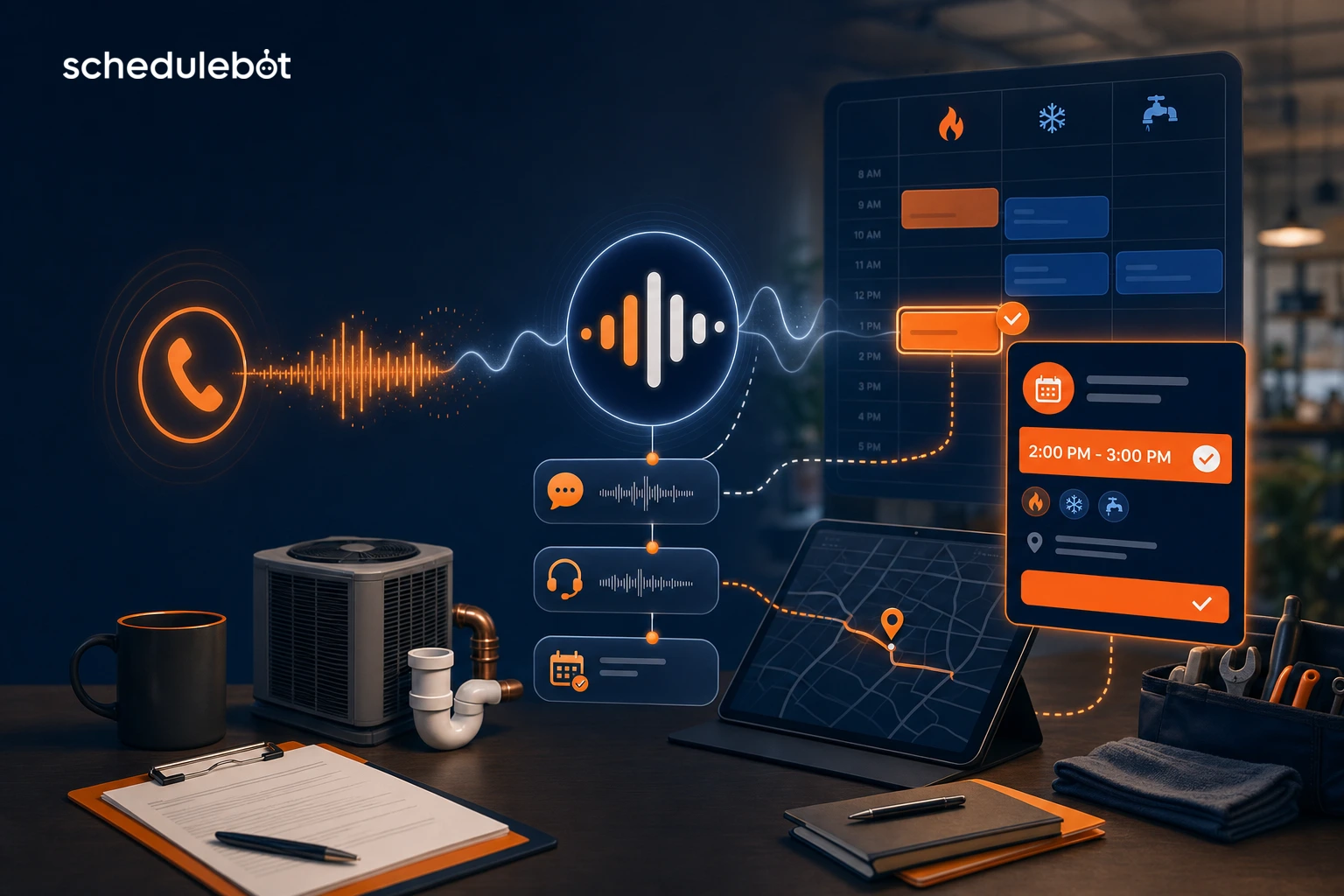
An AI receptionist is software that answers inbound calls or chats, asks qualifying questions, identifies the customer's need, and moves the request to the right next step. For home service contractors, the strongest AI receptionist does more than say hello. It captures the issue, checks service rules, supports CSRs, and books qualified jobs into the CRM when possible.
That definition matters because the term AI receptionist is getting used for everything from simple call scripts to full booking automation. A contractor shopping for an AI answering service should be clear about the outcome they want. Are they trying to answer more calls? Reduce voicemail? Handle after-hours emergencies? Support busy CSRs? Or actually get more booked jobs onto the dispatch board?
For HVAC, plumbing, electrical, roofing, garage door, and other home service companies, the best answer is usually a mix of all five. Customers call when systems break, pipes leak, panels spark, roofs drip, or an estimate question becomes urgent. If the office is closed or the call queue is backed up, the customer does not wait long. They call the next company.
An AI receptionist handles the first mile of customer intake. It answers quickly, understands what the customer needs, collects the right details, and decides where the conversation should go next. In a home service environment, that usually means identifying the trade, job type, urgency, service location, customer status, and preferred appointment timing.
A basic AI answering service may only capture a message and send it to the office. A stronger AI phone answering service can use contractor-specific rules to decide whether the request should be booked, escalated, transferred, texted, or held for CSR review. The difference is important. Message taking creates a follow-up task. Booking automation creates a scheduled opportunity.
For example, an AI receptionist for HVAC might separate a no-cool emergency from a maintenance tune-up or replacement estimate. An AI receptionist for plumbing might treat an active leak, sewer backup, water heater issue, and fixture install differently. Those distinctions affect urgency, routing, appointment length, technician skill, and whether the job should wake up an on-call team.
Traditional answering services can be useful when the main goal is making sure a human picks up. But many of them are built around generic scripts and message slips. The contractor still has to call back, re-ask questions, check the service area, interpret urgency, look at the schedule, and manually enter the job.
An AI receptionist should be measured by how much of that work it can structure before the office touches the lead. The best workflow collects cleaner information, applies the company's rules consistently, and pushes the request into the systems the team already uses.
| Capability | Traditional answering service | AI receptionist for home services |
|---|---|---|
| Answers after hours and during overflow | Yes | Yes, 24/7 |
| Asks trade-specific intake questions | Sometimes | Yes, based on configured rules |
| Checks service area or branch logic | Limited | Yes, when configured |
| Books into CRM availability | Usually no | Yes, in supported workflows |
| Works across phone, chat, forms, and SMS | Usually separate | Yes, as a connected intake layer |
| Supports CSR reporting and follow-up | Limited | Yes, with tracked leads and booking outcomes |
The practical question is not whether the voice sounds realistic. It is whether the system helps the contractor convert more demand into booked work without creating a mess for the office.
Contractors should consider an AI receptionist when they have valuable demand coming in faster than the office can consistently handle. That can happen during after-hours windows, lunch breaks, peak season, weather events, marketing campaigns, technician schedule changes, weekends, holidays, or normal call center overflow.
The signal is usually easy to see. Calls go unanswered. Voicemails pile up. CSRs call customers back after they already booked elsewhere. Paid leads from Google LSA, PPC, SEO, referrals, and Google Business Profile do not always become appointments. The team knows there is demand, but the intake path leaks.
An AI receptionist is most useful when the company already has a defined service area, repeatable job categories, booking rules, and a CRM or dispatch system. It is less useful if every request requires a complex custom estimate or owner approval before anyone can take the next step.
Home service intake has to be more precise than a generic front-desk script. At minimum, the AI receptionist should collect the customer's name, phone number, address, issue, urgency, trade, service category, and preferred timing. It should also identify whether the customer is new or existing when that data is available.
From there, the workflow should adapt by trade and job type. HVAC teams may need equipment symptoms, no-heat or no-cool urgency, system age, membership status, or replacement intent. Plumbing teams may need active leak status, sewer backup indicators, water shutoff instructions, water heater details, or whether the issue is inside or outside the home. Electrical teams may need safety symptoms and escalation rules.
This is why a contractor should avoid evaluating AI receptionist tools only by the demo voice. The setup behind the voice matters more: service areas, job types, business units, priorities, booking windows, emergency rules, transfer destinations, and CRM mappings.
Garage door calls are a good example of why trade-specific triage matters. A homeowner whose door is stuck open at 9pm has a security problem. A customer whose car is trapped inside cannot get to work in the morning. A broken spring, a door off its track, an opener that stopped responding, and a request for a new door quote all sound like "my garage door" on the phone, but they need very different handling.
An AI receptionist for a garage door company should sort those calls in the first minute:
From there, the AI can apply the company's after-hours rules: book the first available emergency window, page the on-call tech, or create a priority lead for first thing in the morning. Standard repairs get offered normal windows, and replacement inquiries land in front of the sales team with the door size, style, and photos already collected when the workflow allows it.
Garage door companies also tend to get a high share of calls from paid search and Google Local Services Ads, so slow answering is expensive. Welborn Garage, a ServiceTitan garage door company in Dallas-Fort Worth, went live with ScheduleBot online booking in January 2025 and saw three times the conversion rate from online scheduling and an 18 percent increase in monthly revenue while spending the same amount on marketing. See how ScheduleBot works for garage door companies.
The best use of AI receptionist software is not to pretend every call should be automated. It is to give CSRs leverage. Routine intake, after-hours coverage, overflow calls, abandoned form sessions, and basic scheduling questions can be handled consistently while the office team focuses on the calls where human judgment matters most.
That includes upset customers, warranty questions, financing, memberships, dispatch exceptions, multi-issue jobs, commercial accounts, complex reschedules, and high-value estimates. Instead of starting every morning with vague messages and cold callbacks, CSRs can see cleaner records with the customer's issue, context, and booking status.
ScheduleBot is built around that support model. AI Voice handles inbound and overflow calls. AI Chat helps website visitors get answers and move toward booking. AI Forms let customers schedule online with guided intake. SMS and follow-up workflows help recover leads that did not book on the first try.
CRM booking is where an AI receptionist moves from front-desk coverage to revenue operations. A message in an inbox still requires a human to decide what it means. A qualified appointment in the CRM gives dispatch and the office a cleaner next step.
ScheduleBot is built for home service companies that want calls, chats, forms, and texts connected to real scheduling. In supported workflows, ScheduleBot can check availability, apply booking rules, and create jobs or leads in systems like ServiceTitan and Housecall Pro. It can also stop short of booking when a request needs human review, which is better than forcing a bad appointment onto the board.
This matters for contractors with multiple branches, territories, business units, service categories, same-day rules, capacity limits, or emergency priorities. The AI receptionist should not just sound helpful. It should respect the operating model of the company.
Not every AI receptionist is ready for home services. Contractors should be cautious when a tool cannot explain how it handles service areas, emergency routing, CRM booking, missed-call recovery, transfer rules, or CSR handoff. A generic assistant may answer politely but still create operational cleanup.
Watch for these gaps:
ScheduleBot is an AI receptionist and scheduling layer built specifically for home service companies. The product is designed to answer calls, chats, and forms, qualify the customer, apply contractor-specific rules, and book qualified jobs into the CRM when the workflow supports it.
That makes ScheduleBot different from generic AI answering tools. The goal is not only to reduce missed calls. The goal is to turn customer intent into booked work across the channels contractors already rely on. That includes after-hours answering, peak-season overflow, AI phone answering service coverage, website chat, online forms, SMS follow-up, and reporting on booked and unbooked leads.
For contractors comparing options, the key question is simple: will this tool merely answer the phone, or will it help put more jobs on the board? ScheduleBot is built for the second outcome.
Want to hear it on your own calls? Book a 20-minute demo and we will walk through how ScheduleBot would answer, triage, and book your after-hours and overflow calls into your CRM.
This article is part of ScheduleBot's broader guide to home service answering service and scheduling software, which covers how contractors connect calls, chat, forms, SMS, and CRM scheduling into one lead-to-booked-job workflow.
An AI receptionist is software that answers calls or chats, asks intake questions, qualifies the customer, and routes the request to the right next step. For home service companies, the best AI receptionist can also book appointments into the CRM or create a clean lead for CSR follow-up.
Yes, when it is connected to the contractor's booking rules, service area, job types, and CRM availability. An AI receptionist for HVAC or plumbing can identify the issue, check urgency, and move the customer toward a real appointment instead of only taking a message.
No. A live answering service usually depends on human agents and often stops at message taking. An AI answering service can run 24/7, follow consistent intake rules, connect across voice, chat, forms, and SMS, and book or route the job when integrated with the contractor's systems.
Contractors should use an AI phone answering service when they miss calls after hours, have peak-season overflow, spend money on leads they cannot answer fast enough, or want CSRs focused on complex calls instead of repetitive intake.
Yes. A well-configured AI receptionist can separate urgent garage door calls, like a door stuck open, a car trapped inside, or a door off its track, from standard repairs and replacement quotes. It then applies the company's after-hours rules to book an emergency window, alert the on-call technician, or create a priority lead.
ScheduleBot is designed to support CSRs, not just replace them. It handles routine intake, after-hours coverage, overflow calls, website chat, forms, SMS follow-up, and CRM booking so the office team can focus on exceptions, relationships, and higher-value work.