Missed Call Recovery, Call Tracking, Revenue Attribution, Home Services
7 min read
How to Measure Missed-Call Recovery ROI for Home Service Companies

September 24, 2026







If you run an HVAC, plumbing, or electrical company, you probably track:
But the number that truly drives growth is this:
Because revenue doesn’t come from leads.
It comes from booked jobs.
Most home service companies convert between 40% and 60% of all inbound leads. For online scheduling specifically, that number is often much lower - like 20-30%.
If you’re investing heavily in marketing but not maximizing bookings, you’re leaving revenue on the table.
This guide breaks down exactly how to increase lead-to-job conversionin HVAC, plumbing, and electrical companies.
Lead-to-job conversion rate is the percentage of inbound leads that turn into scheduled jobs.
Formula:
Booked Jobs ÷ Total Leads = Conversion Rate
Example:
200 inbound leads
120 booked jobs
120 ÷ 200 = 60% conversion rate
Improving this percentage is one of the highest leverage operation all improvements a home service company can make.
Before we improve it, we need to understand what’s holding it back.
When CSRs are busy, calls go to voicemail.
Every missed call lowers your conversion rate.
Customers don’t wait. They call your competitor.
If someone fills out a website form and waits hours for a response,they often call another company.
Speed-to-lead wins.
Many online schedulers:
This hurts HVAC, plumbing, and electrical companies especially during peak seasons.
Even strong teams can vary:
Inconsistency reduces conversion and dispatch quality.
The first and most powerful improvement:
Respond immediately.
Conversion drops quickly as response time increases.
To improve speed:
The faster you respond, the higher your lead-to-job conversion.
If 5–15% of your total jobs come from online scheduling, optimizing that system alone can significantly increase revenue.
High-performing online scheduling systems:
Most traditional schedulers convert around 20–30%.
Intelligent scheduling systems can significantly outperform that.
For a deeper breakdown of why online schedulers convert poorly, see our article on improving online scheduling conversion.
Many customers begin booking but never finish.
Without recovery:
They disappear.
With recovery:
You can re-engage them automatically.
Automated follow-up through SMS or chat can recover a meaningful percentage of lost booking attempts.
This is especially powerful in HVAC during peak heat or cold seasons when urgency is high.
Your conversion rate depends on consistency.
Your booking process should:
AI booking systems help enforce consistency.
They operate like your best CSR every time.
Many companies obsess over lowering cost per lead.
But if your conversion rate is low, cheaper leads don’t solve the problem.
Example:
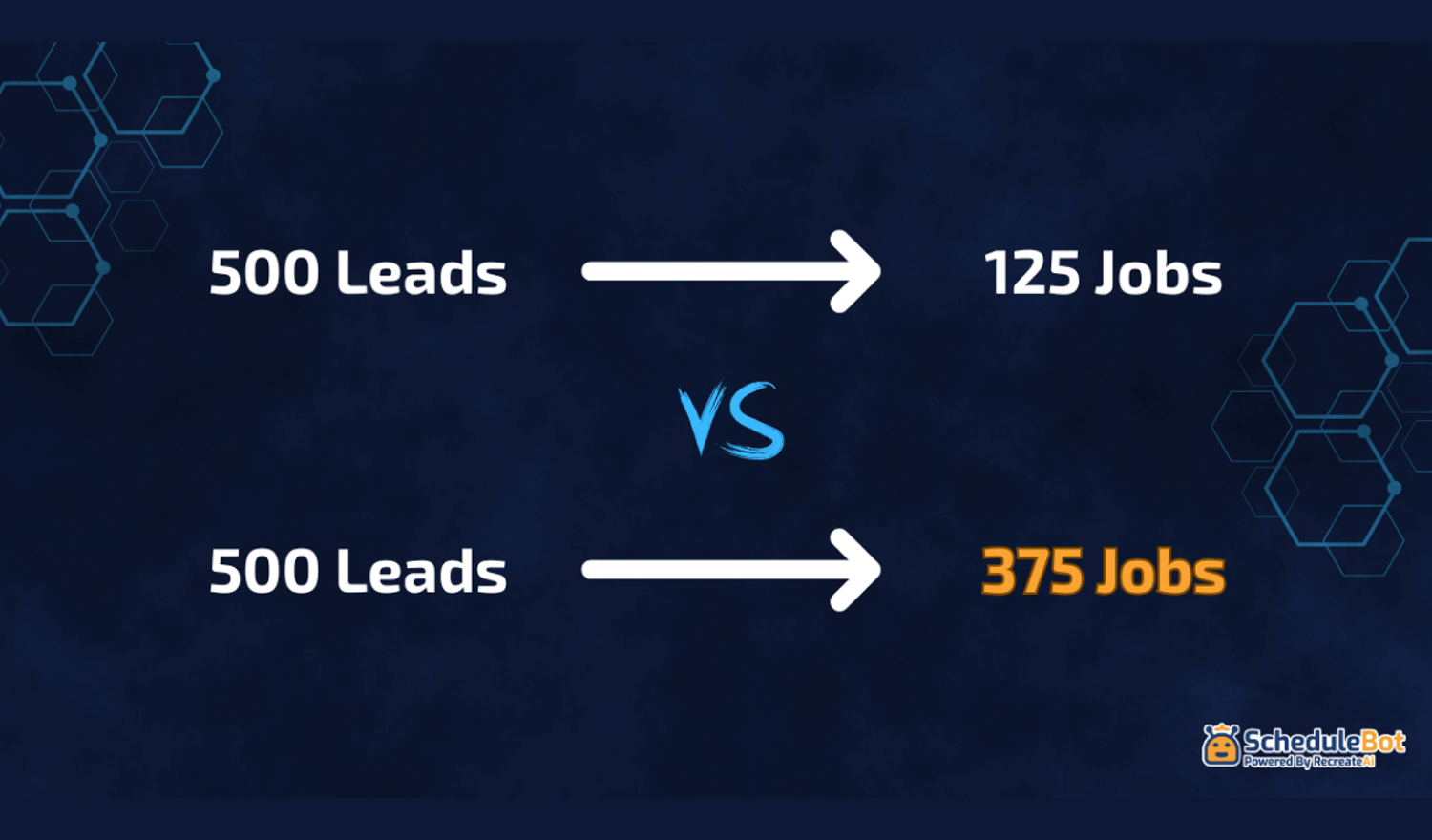
500 leads at $50 each = $25,000 spend
At 20% conversion → 100 jobs
At 70% conversion → 350 jobs
Same spend.
250 more jobs.
This lowers cost per booked job dramatically.
That is the metric that drives profitability.
For a deeper dive into this metric, see our guide on Al booking software for home service companies.
HVAC companies often struggle during peak demand.
To improve conversion:
If a customer mentions a 15-year-old system, that should trigger urgency.
Plumbing leads often involve emergencies.
To improve booking rate:
Urgency improves conversion.
Electrical jobs vary widely.
Panel upgrades, breaker issues, EV chargers, lighting installs.
To increase booking rate:
Clarity increases trust.
The highest-performing home service companies don’t rely on one intake channel.
They combine:
This creates full coverage.
Every lead is captured.
Every lead is followed up.
Every lead has the best opportunity to convert.
Improving conversion rate leads to:
The growth comes from operational efficiency, not just marketing expansion.
Many HVAC companies operate between 50–65% overall. Online scheduling specifically is often lower unless optimized.
Improving conversion often delivers faster ROI than increasing spend.
No. It supports your team by handling overflow, after hours, and standardized intake.
If you want to increase lead-to-job conversion in HVAC, plumbing, or electrical:
Start with speed.
Fix online scheduling.
Recover abandoned leads.
Standardize intake.
Measure cost per booked job.
Most companies try to grow by generating more leads.
The smarter move is converting more of the leads you already have.
Because in home services, growth is often hidden inside your booking process.